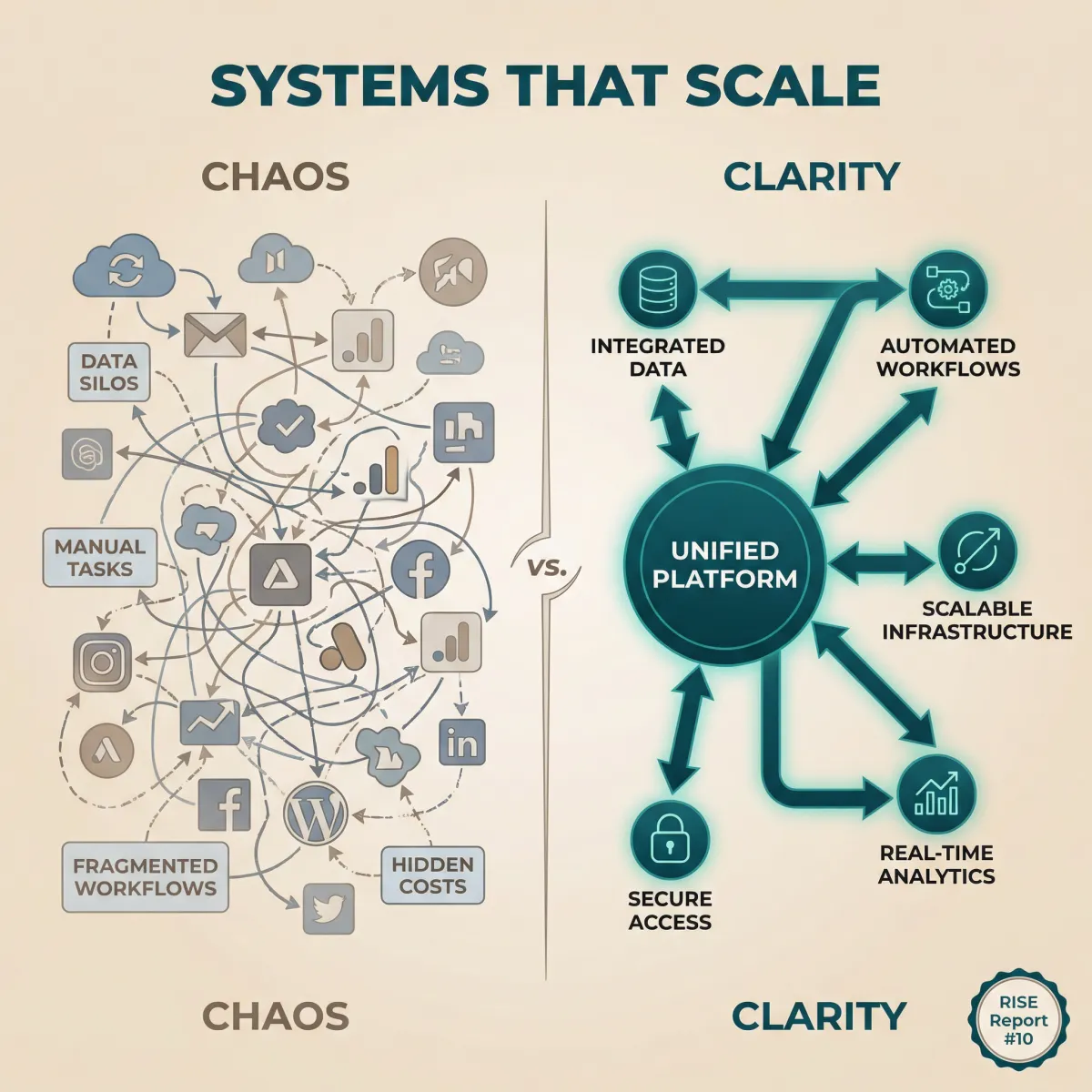
Systems That Scale: Build Once, Benefit Forever
You don't need more subscriptions.
You need infrastructure you own.
Every month, you're paying for tools that promise to solve your problems. But six months later, you're still doing the same manual work because the tool didn't build the system for you.
THE CORE INSIGHT
There's a fundamental difference between renting automation and owning systems.
Renting automation: You pay monthly for a tool. The tool does something for you. When you stop paying, the automation stops working.
Owning systems: You build infrastructure once. It runs regardless of which tools you use. You can switch platforms without rebuilding from scratch.
Most business owners are trapped in subscription dependency. They've outsourced their operational intelligence to software companies.
Here's what that looks like:
You use Tool A for email sequences. Tool B for scheduling. Tool C for lead tracking. Tool D for client management.
Each tool has its own login, its own logic, its own limitations.
When one raises prices or shuts down, you panic. Because your entire system lives inside that tool.
You don't own your infrastructure. You rent it.
This is backwards.
Your business systems should be tool-agnostic. The logic belongs to you. The tools are interchangeable.
Systems that scale are built on ownership, not dependency.
REVIEW: Name the Friction
When you rent your systems instead of owning them, here's the cost:
SUBSCRIPTION STACK GROWS ENDLESSLY: Every problem gets solved with "there's a tool for that." Your monthly SaaS bill hits $500, $1,000, $2,000. You're paying for features you don't use because you need the one thing the tool does.
YOU CAN'T SWITCH WITHOUT STARTING OVER: Tool raises prices 40%. You're stuck. Because switching means rebuilding everything from scratch. Your systems live in their platform, not in your documentation.
TOOLS DON'T TALK TO EACH OTHER: You manually export from Tool A to import into Tool B. Or you pay for another tool (Zapier, Make) to connect them. More subscriptions to solve problems created by having too many subscriptions.
YOUR TEAM DEPENDS ON PLATFORM-SPECIFIC KNOWLEDGE: You hire someone who knows Tool C. They leave. New person doesn't know Tool C. You either train them on the tool or switch tools and rebuild. Either way, the system knowledge walked out the door.
YOU CHASE FEATURES INSTEAD OF SOLVING PROBLEMS: Tool announces new AI feature. You migrate to take advantage. Three months later, you're not using it. But now you're locked into the new platform.
Sound familiar?
This is subscription dependency. You're renting infrastructure instead of owning it.
The shift:
What if you documented the system logic separately from the tools?
What if your onboarding process lived in a doc, not buried in ClickUp/Asana/Monday.com settings?
What if your email sequences were written as a flowchart that could be implemented in any email platform?
That's ownership.
IMPLEMENT: One Thing to Try
Pick ONE system you're currently renting through a subscription tool.
This week, you're going to separate the system logic from the tool implementation.
STEP 1: Document the logic (10 minutes)
Open a Google Doc, Notion page, or simple text file.
Write down:
What this system does (the outcome, not the tool)
What triggers it to start
What steps happen in sequence
What decision points exist
What the end result should be
Example: Client Onboarding
Current state: "We use Dubsado for client onboarding."
System logic documentation:
TRIGGER: New client signs contract STEPS:
1. Send welcome email with portal access
2. Create project folder (Google Drive)
3. Schedule kickoff call (30 min, Tuesdays/Thursdays)
4. Send pre-call questionnaire
5. Assign to team member based on service type DECISION POINTS:
- If service type = Strategy → Assign to [Name]
- If service type = Implementation → Assign to [Name] END RESULT: Client has access, kickoff scheduled, team assigned
See the difference?
The first statement ("we use Dubsado") gives you nothing if Dubsado shuts down tomorrow.
The second statement is tool-agnostic. You could rebuild this in any CRM, or manually if needed.
You now own the system logic.
STEP 2: Identify what's tool-dependent (5 minutes)
Review your documentation.
Mark anything that ONLY works in your current tool:
Specific integrations
Custom fields that don't exist elsewhere
Automations built on that platform's unique features
Ask: If this tool disappeared, what would I lose?
Most of the time, you'd lose convenience rather than capability. The system can be rebuilt. You just need to own the logic.
STEP 3: Store the documentation (2 minutes)
Put this somewhere accessible:
Notion workspace
Google Drive folder
GHL knowledge base
Simple doc library
Title it clearly: "System Logic: Client Onboarding"
Now you own this system.
If the tool changes, raises prices, or shuts down, you're not starting from scratch. You're just re-implementing known logic in a new tool.
Total time: 17 minutes
That's all it takes to move from renting to owning.
STREAMLINE: Make It Easier
Now that you've documented one system, make this your default approach for everything.
BEFORE you subscribe to any new tool, ask:
1. What system am I trying to build? Write the logic first. Document the desired outcome. Map the process.
2. Can I build this in a tool I already own? GHL can handle 80% of what specialized tools do. Most subscription stacks can be consolidated into 2-3 core platforms.
3. If I stop paying for this tool in 6 months, do I still own the system? If no → You're renting, not owning. Document the logic separately before implementing.
THE OWNERSHIP CHECKLIST:
Before adding any subscription:
[ ] I've documented the system logic in a tool-agnostic format
[ ] I've checked if existing tools can handle this
[ ] I know exactly what I'd lose if this tool disappeared
[ ] The core system knowledge lives outside the platform
[ ] I'm choosing this tool for convenience, not dependency
Tools to support ownership:
GHL (all-in-one): CRM, email, SMS, funnels, scheduling, workflows, forms
Notion (documentation): System logic, SOPs, process maps
Google Workspace (infrastructure): Drive, Docs, Sheets for permanent storage
Make/Zapier (connections): Only for tools that must talk to each other
The goal: 2-3 core platforms, not 15 specialized tools.
EXPAND: Where This Leads
Here's what happens when you shift from subscription dependency to system ownership:
Week 1: You document one system. It feels tedious. But now you own the logic.
Week 2: Tool raises prices. Instead of panicking, you review your documentation. You could rebuild this elsewhere in an afternoon.
Week 3: You consolidate three tools into GHL because you own the system logic. Save $200/month. Zero loss of capability.
Week 4: New team member joins. You hand them the documented systems. They understand the logic, not just "how to click buttons in Tool X."
Month 2: You've documented 5 core systems. Your subscription stack drops from $1,200/month to $400/month.
Month 3: A tool you rely on announces shutdown. You're calm. You own the system. You'll migrate it in a weekend.
Month 6: Someone asks, "What tools do you use?" You realize the question doesn't matter. You use whatever implements your systems most efficiently. The tools are interchangeable.
This is infrastructure ownership.
You're no longer dependent on any single platform. You're no longer paying rent on systems you should own.
The business runs on your logic, not someone else's software.
When tools change, you adapt. You don't rebuild from scratch.
When prices increase, you evaluate alternatives. You're not trapped.
When new team members join, you train them on systems. The tools are just implementation details.
This is how systems actually scale.
Not by adding more subscriptions. By owning the infrastructure those subscriptions are built on.
QUICK WIN: 5-Minute Action
Right now, open your subscription list.
Find your most expensive SaaS tool (that's not GHL or core infrastructure).
Ask yourself:
"If this tool disappeared tomorrow, could I rebuild what it does?"
If the answer is no, you don't own that system. You're renting it.
Your action:
Spend 10 minutes this week documenting what that tool actually does for you.
Not "I use HubSpot" or "I use Asana."
But: "This tool manages our lead follow-up by sending 5 emails over 14 days based on lead source."
Write that down. Outside the tool. In your own documentation.
Now you own it.
Even if you keep using the tool, you've separated the system logic from the platform dependency.
That's the first step to ownership.
You don't need more tools.
You need to own your systems.
Every subscription should be a choice, not a dependency.
Document the logic. Build tool-agnostic infrastructure. Own your operational intelligence.
That's how systems scale.
What would shift if you owned your systems instead of renting them?
If you're ready to build infrastructure you control:
→ Book a Business Analyzer Audit (free) - We'll review your subscription stack and identify what you should own vs. rent.
Take the Audit
→ Explore GHL Implementation - Consolidate your tools into one platform you control. We'll migrate your systems without losing functionality.
Learn More
Ready to build once and benefit forever? Let's chat!
Let me know, what's the most expensive subscription that you feel trapped by?
I read every response.
See you next week!
P.S. Next week's RISE Report: "The 3 Cs Framework" - why order matters when building business systems.
