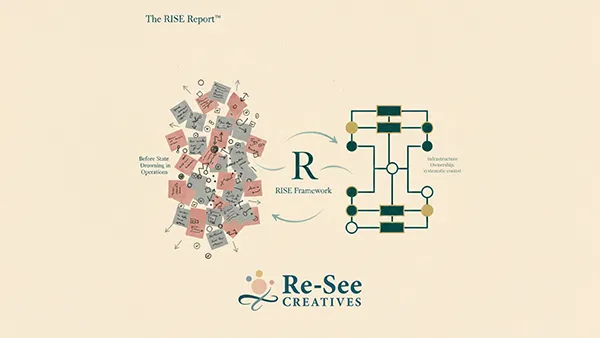
THE RISE REPORT™: Why I Built the RISE Framework™
You can have all the talent, all the passion, and all the drive in the world—and still feel like you're drowning.
I learned this the hard way.
After 25+ years building operational infrastructure for Fortune 500 companies—managing complex implementations, leading enterprise-level projects, earning my PMP and CSM certifications—I thought entrepreneurship would be straightforward.
I had the skills. I had the experience. I knew how to build systems that scaled.
But when I launched my own business, something unexpected happened.
I became the bottleneck.
Every client question came to me. Every decision waited for my approval. Every invoice, every email, every operational choice—all me, all the time.
I was working 60-hour weeks and barely keeping up with a handful of clients.
Sound familiar?
THE PROBLEM WASN'T LACK OF KNOWLEDGE
Here's what made it worse: I knew what was wrong.
I could look at any other business and immediately spot the operational gaps. I could design systems for clients that saved them hours every week. I could build infrastructure that ran without constant oversight.
But in my own business? I was trapped in execution mode.
The cobbler's children have no shoes.
I'd spend two hours creating a client presentation, then realize I'd created nearly identical presentations six times in the past month. I'd answer the same client questions repeatedly because I hadn't documented the answers. I'd manually track leads in my head because I hadn't set up a proper system.
I wasn't working smarter. I was just working more.
And here's the truth nobody tells you: More hours doesn't equal more revenue when you're the bottleneck.
You can't scale personal bandwidth. You can only redistribute operational load.
THE TURNING POINT
One night at 11 PM, I was creating yet another client deliverable.
My family was asleep. My coffee was cold. My eyes were burning from staring at the screen.
And I had this moment of clarity that changed everything:
I was solving the same problems over and over again.
The clients were different. The projects looked different. But the underlying issues? Almost identical every time:
Unclear positioning. They couldn't explain what they did in one sentence. Their expertise was buried under vague language and industry jargon. Brilliance without clarity doesn't scale.
Scattered systems. Tools that didn't talk to each other. Data living in five different places. Manual work bridging gaps between platforms. Renting solutions instead of owning infrastructure.
Inconsistent visibility. Great work, no one knew about it. Expertise hidden behind inconsistent content. Authority without amplification goes unrecognized.
Manual everything. Copying data. Answering the same questions repeatedly. Creating from scratch instead of systematizing. Time spent doing instead of building.
That's when the RISE Framework™ was born.
Not as a marketing concept. Not as a theoretical model.
As a survival mechanism.
WHAT IS THE RISE FRAMEWORK™?
RISE is how I stopped drowning and started scaling.
It's the exact process I use to transform businesses from operationally overwhelmed to strategically owned. It's also the sequence I followed to reclaim 15+ hours per week in my own operations.
The framework has four phases. Order matters.
R — REVIEW: Where Are You Actually Stuck?
Most business owners think they need "better marketing" or "more sales."
But when you look deeper, the real issue is usually something else entirely.
Maybe their offer is unclear. Maybe their ideal client is too broad. Maybe they're solving the wrong problem. Maybe their business outgrew their systems and they're running a $100k operation with $20k infrastructure.
Review is about getting brutally honest about what's working and what's not—and why.
This isn't about beating yourself up. It's about clarity.
You can't fix what you can't see clearly.
When I finally reviewed my own operations, I discovered:
I was creating unique presentations for recurring deliverables (could be templated)
I answered 80% of client questions manually (could be systematized)
I tracked leads in my head (needed actual infrastructure)
I made the same operational decisions repeatedly (could be decided once)
The questions I ask:
Where does time actually go? (Not where you think it goes, where it actually goes)
What work is repetitive but done manually?
What decisions do you make over and over?
Where does communication break down?
What would happen if you took a week off right now?
That last question reveals everything.
If your business can't run for a week without you, you don't have infrastructure. You have a demanding job.
I — IMPLEMENT: What's the Fastest Path to Momentum?
Once you know what's broken, you need quick wins.
Not a 47-step plan that takes six months. Not vague advice about "showing up consistently." Specific actions that create immediate results.
Implementation is about choosing the right first step, not trying to fix everything at once.
Here's what I implemented first in my own business:
Week 1: Documented my client onboarding process. Just wrote down every step I was doing. Took 30 minutes. Immediately revealed three steps that could be automated.
Week 2: Created templates for my three most common client deliverables. Saved 5+ hours that week alone.
Week 3: Set up a basic lead tracking system in a spreadsheet. Nothing fancy. Just stopped keeping it all in my head. Mental bandwidth immediately freed.
Week 4: Wrote down answers to the 10 most common client questions. Created saved replies. Turned 20-minute responses into 2-minute responses.
Notice what I didn't do:
Subscribe to five new tools
Rebuild my entire website
Launch a new service
Create a complex automation system
I started with documentation and templates. The boring stuff that creates actual leverage.
Most people skip this step. They jump straight to buying software or hiring help. But you can't automate what you haven't documented. You can't delegate what you haven't systematized.
Implementation is about grounded action, not creative solutions.
S — STREAMLINE: How Do We Make This Run Without You?
This is where infrastructure comes in.
Once you know what works (Review) and you've proven it with documentation (Implement), you can systematize it.
Streamline is about buying back your time so you can focus on growth, not grind.
But here's the key: You're not streamlining to do more work. You're streamlining to create space.
Space to think strategically. Space to rest. Space for your business to run while you step away.
In my business, streamlining looked like:
Moving client onboarding into GHL workflows (eliminated 3 hours of manual work per new client)
Creating a content repurposing system (one piece becomes 10-15 touchpoints automatically)
Building decision trees for common scenarios (stopped making the same choice repeatedly)
Setting up automated follow-ups (leads don't fall through cracks)
The goal isn't "automate everything." It's "systematize the predictable parts so you have bandwidth for the strategic parts."
There's a difference between:
Renting automation (paying monthly for tools you don't fully own)
Owning infrastructure (building systems that run regardless of which tool you use)
I chose infrastructure ownership.
When a tool raises prices or shuts down, I'm not scrambling to rebuild. I own the system logic. The tool is just the implementation layer.
This is the shift from operator to CEO.
E — EXPAND: What Does Scale Look Like for YOUR Business?
Expansion isn't always about adding clients.
Sometimes it's launching a digital product. Sometimes it's hiring your first team member. Sometimes it's finally taking Fridays off without your phone buzzing constantly.
Expand is about defining success on your terms and building systems that support that vision.
For me, expansion meant:
Taking on higher-level strategic work (instead of being buried in execution)
Creating productized services (repeatable offerings with clear scope)
Building systems others can run (so growth doesn't require more of my hours)
Protecting creative space (where strategy and innovation actually happen)
The RISE Framework™ isn't linear. You cycle through it repeatedly as your business evolves.
But the sequence matters. Clarity → Confidence → Creativity.
You can't skip to expansion when you're still unclear about where you're stuck (Review). You can't systematize what you haven't proven through documentation (Implement). And you can't scale what doesn't run smoothly (Streamline).
Order matters.
WHY THIS FRAMEWORK WORKS
Most business advice tells you to do more.
More content. More outreach. More hustle. More complexity.
The RISE Framework™ tells you to get clear first, then build infrastructure second, then expand from strength third.
It's not about doing more. It's about owning what you do.
Here's what changed for me after implementing RISE in my own business:
Before:
Working 60-hour weeks
Handling 5-7 clients maximum
Every task required me
No documentation
Constant firefighting mode
Exhausted, overwhelmed, trapped
After:
Working 35-40 hour weeks
Capacity for 10-15 clients
Systems handle predictable work
Everything documented
Strategic thinking mode
Energized, in control, scaling
The difference wasn't working harder. It was working systematically.
THE REAL COST OF NOT HAVING SYSTEMS
Here's what I realized after years of helping business owners:
The problem isn't lack of talent. It's not lack of work ethic. It's not even lack of clients.
The problem is treating your business like a series of one-off tasks instead of a system that can run without constant input.
When everything depends on you:
You can't take a vacation without your phone
You can't grow beyond your personal bandwidth
You're building a demanding job, not a scalable asset
Every new client adds operational weight
Your expertise is trapped in execution
But when you have infrastructure:
The business can operate while you're offline
Growth doesn't require more of your hours
You're building an asset, not just income
New clients fit into existing systems
Your expertise creates leverage
This is the difference between being an operator and being a CEO.
WHAT'S NEXT FOR YOU
If you're reading this and recognizing yourself in the "before" version of my story, here's what I want you to know:
You're not failing. Your systems are.
You don't need to work harder. You need infrastructure that matches your expertise level.
The RISE Framework™ isn't complicated. But it does require you to pause the hustle long enough to build something sustainable.
Here's where to start:
This week, do a 5-minute Review:
Answer these questions honestly:
What work am I doing repeatedly that could be documented once?
What decisions do I make over and over that could be decided once?
If I disappeared for a week, what would break?
Where am I the bottleneck in my own business?
Write down your answers. Don't solve anything yet. Just see it clearly.
Next week, pick ONE thing to Implement:
Not five things. One.
Document it. Template it. Write it down.
That's momentum.
A NOTE ON "QUICK FIXES"
I need to be honest with you about something:
The RISE Framework™ will not give you overnight results.
It's not a hack. It's not a shortcut. It's not a magic tool that solves everything instantly.
It's a methodology for building infrastructure that scales.
If you're looking for "10X your revenue in 30 days" promises, this isn't it.
But if you're tired of drowning in operations and you're ready to build something sustainable, this is exactly what you need.
The work is simple. It's just not fast.
And that's okay.
Because six months from now, you'll either have spent another six months drowning in the same operational chaos, or you'll have built systems that give you back your time.
The choice is yours.
THE ORIGIN OF "RE-SEE"
People often ask about the name.
"Re-See Creatives" isn't just a play on my name (though Reci → Re-See was convenient).
It's about the core transformation I help people make:
Re-seeing their business.
Not as a series of tasks to grind through.
Not as a demanding job disguised as entrepreneurship.
But as a system that can be owned, optimized, and operated strategically.
You can't change what you can't see differently.
That's what the RISE Framework™ does. It helps you re-see where you're stuck, what's possible, and how to build infrastructure that actually works for you.
WHAT'S NEXT IN THE RISE REPORT™
This newsletter exists to document my journey and share what actually works.
No theory. No fluff. Just operational infrastructure insights from someone who's building in real time.
Coming in future issues:
The 3 Cs Framework: Why Clarity → Confidence → Creativity is the only sequence that works
System Ownership vs. Subscription Dependency: How to build infrastructure you control
The Undecided Tax: Why you're exhausted from deciding, not from working
The Decided Life: Making decisions once instead of repeatedly
Authority Spine: The invisible infrastructure that supports expertise
Every Tuesday, you'll get one framework, one insight, and one action you can take to build systems that scale.
No hype. No hustle culture. Just infrastructure.
ONE FINAL THING
If you're still reading, you're probably wondering: "Is this for me?"
Here's how you know:
This is for you if:
You're brilliant at your work but drowning in operations
You started a business for freedom but feel trapped in execution
Your expertise outgrew your systems
Every question comes to you, every decision waits for you
You're working harder than you did in corporate but making less per hour
You know there has to be a simpler way
This isn't for you if:
You're looking for quick hacks or overnight results
You want someone to do the work for you without understanding it
You're not willing to pause long enough to build infrastructure
You prefer hustle culture over sustainable systems
The RISE Framework™ is for business owners who are ready to stop grinding and start building.
If that's you, welcome to The RISE Report™.
I'm glad you're here.
Twenty-five years of corporate systems experience didn't save me from becoming my own bottleneck.
But it did give me the tools to build a framework that transformed operational chaos into strategic infrastructure.
The RISE Framework™ was born from necessity, refined through implementation, and proven through results.
Now it's yours.
Use it. Build with it. Scale with it.
And if you get stuck, reach out. I respond to every message.
See you next week,
Marecia
What would shift if you stopped being the bottleneck?
If you're ready to move from operator to CEO through systematic infrastructure:
→ Subscribe to The RISE Report™ - Get weekly insights every week
Subscribe Here
→ Book a Business Analyzer Audit (free) - See exactly where you're stuck and what comes next
Take the Audit
→ Explore the RISE Framework™ - Deep dive into the complete methodology
Learn More
Ready to stop drowning and start owning your systems?
Reply to this email and tell me: What's the one thing in your business that you do repeatedly but have never documented?
I read every response.
P.S. The RISE Framework™ didn't solve everything overnight. But six months after implementing it in my own business, I got my weekends back. That's worth more than any revenue target.
